
Inspecting jewelry craftsmanship before buying is the practice of evaluating a piece’s quality, authenticity, and structural integrity through visual checks, tactile assessment, and documentation review. A beautiful surface finish can hide sloppy solder joints, misaligned prongs, or missing hallmarks. Knowing what to look for protects you from overpaying for inferior work or, worse, purchasing an outright counterfeit. This guide walks you through every layer of evaluation, from metal purity stamps to gemstone setting security, so every piece you bring home is genuinely worth treasuring.
What hallmarks and purity marks tell you about metal authenticity
Hallmarks are the first thing to verify when you evaluate jewelry quality. They are official stamps that confirm a metal’s purity, the maker’s identity, and the piece’s compliance with national or international standards. Without them, any claim about gold or silver content is unverifiable.
In India, the Bureau of Indian Standards system is the most credible framework. A BIS Hallmark includes four marks: the BIS logo, a purity number (such as 916 for 22-karat gold), the jeweler’s registered mark, and a unique 6-digit HUID code. That HUID can be entered into the BIS Care app or the official BIS website to confirm the piece’s weight, purity, and the registered jeweler behind it. This level of traceability is rare in global markets and sets a high bar for what transparency should look like.
Outside India, look for karat stamps such as 750 (18k gold), 925 (sterling silver), or 950 (platinum). European pieces often carry assay office marks from institutions like the London Assay Office or the Vienna Assay Office. American gold jewelry typically carries a karat stamp alongside a maker’s mark.
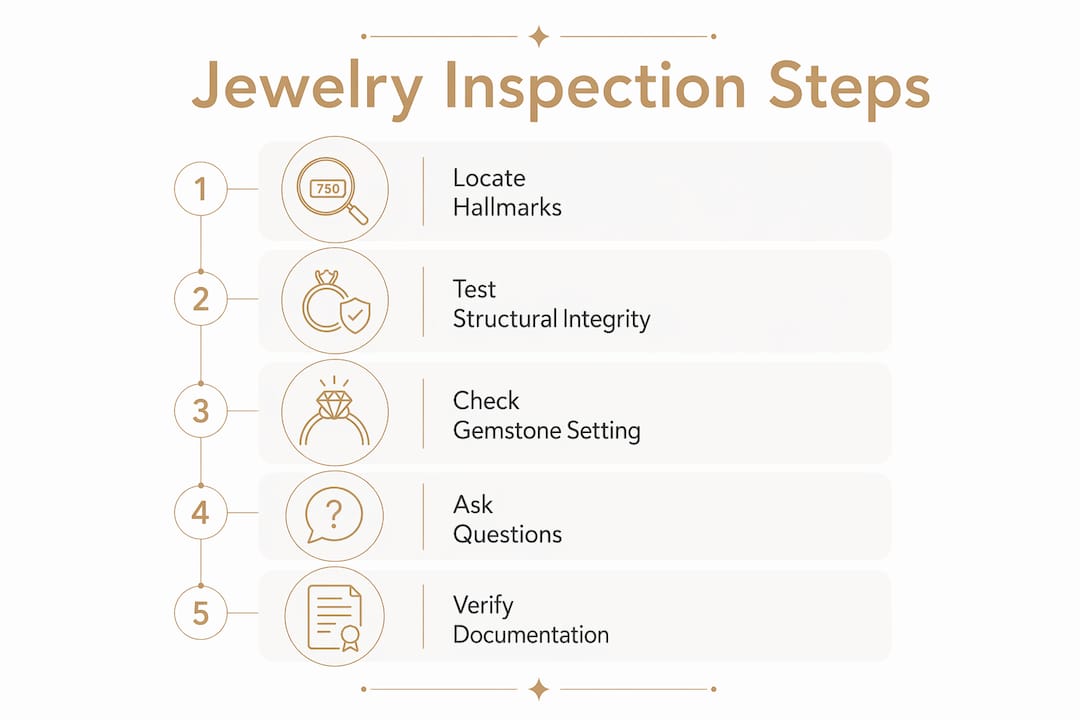
Here is what to check when locating hallmarks:
- Location: On rings, look inside the band. On necklaces and bracelets, check near the clasp. On pendants, inspect the bail or the back of the piece.
- Legibility: Stamps should be crisp and clear, not smudged or partially worn away on a new piece.
- Consistency: The karat stamp and any accompanying certification should match. A piece stamped 18k sold with a certificate claiming 14k is a red flag.
- Presence: A missing hallmark on a piece claiming to be fine metal is grounds to walk away.
Pro Tip: If you are buying online and cannot physically inspect the piece, ask the seller to photograph the hallmark under direct light at close range. Blurry or conveniently absent hallmark photos are a warning sign.
How to assess craftsmanship quality and structural integrity
Craftsmanship quality lives in the details most buyers never think to examine. The face of a piece catches light and draws attention, but the back, the clasp, and the joints reveal how a piece was actually made.
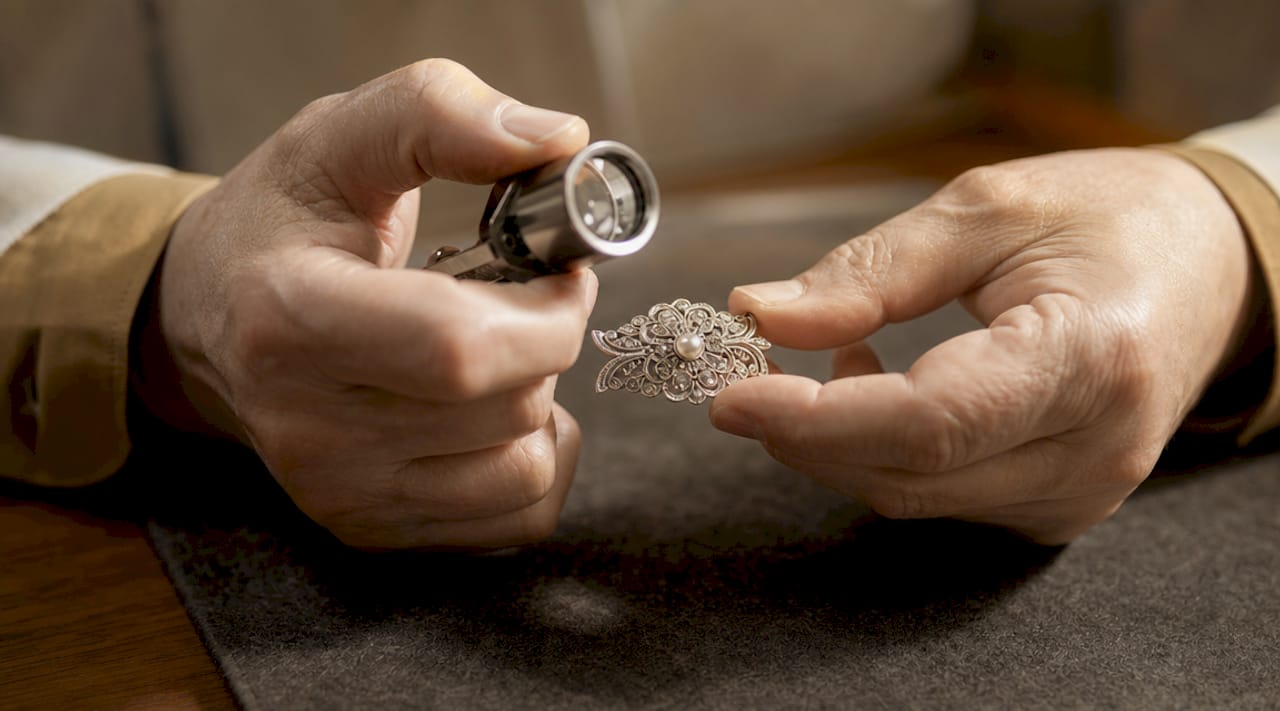
Experts recommend inspecting high-wear joints like clasps and solder lines first, because these areas expose craftsmanship shortcuts better than any surface feature. A lobster clasp that sticks, springs unevenly, or feels gritty signals a component sourced from the cheapest available supplier. Solder joints that look lumpy, discolored, or uneven suggest rushed assembly rather than careful finishing.
Follow these steps to check ring craftsmanship and overall structural quality:
- Examine prong alignment. Prongs should be evenly spaced and symmetrical. Misaligned prongs catch on fabric and eventually release stones.
- Run a finger across all surfaces. Smooth chain draping, secure clasps, and consistent polish signal quality. Rough edges, sharp spots, or uneven texture indicate shortcuts.
- Inspect solder joints under light. Hold the piece at an angle to a light source. Clean joints are nearly invisible. Sloppy ones look like blobs of metal.
- Test the clasp repeatedly. Open and close it at least five times. It should engage with a clean click and release without force.
- Check engraving depth. Shallow engraving fades quickly with regular wear. Deep, crisp engraving indicates superior craftsmanship and durability. Run your fingernail across it; you should feel clear definition.
- Look at the back and underside. Mass-produced pieces often receive minimal finishing on surfaces the wearer cannot see. Hand-finished pieces show consistent polish and attention everywhere.
The difference between hand-finished and machine-made pieces is most visible at the joins and transitions between design elements. Machine-made pieces have uniform but sometimes sterile lines. Hand-finished work shows subtle variation that speaks to individual attention, and the finishing quality at hidden points confirms whether that attention was genuine.
Pro Tip: Bring a small jeweler’s loupe (10x magnification) to in-person evaluations. For online purchases, request videos under neutral light rather than relying on a single studio photo. If a piece looks perfect only in one lighting condition, assume imperfections are being concealed.
What questions should you ask the jeweler before buying?
The right questions reveal whether a seller truly knows their product or is simply repeating marketing language. A confident, knowledgeable jeweler answers these without hesitation. Vague or deflective responses are informative in their own way.
Ask these questions before committing to any purchase:
- “What is the exact metal composition?” This means karat level, alloy metals used (nickel, copper, palladium), and whether any plating is involved. Asking about metal alloy composition and finishing methods separates transparent sellers from those hiding inferior materials.
- “Is this piece cast in-house or outsourced?” In-house casting with hand-finishing typically produces higher quality than outsourced mass production. The answer tells you about the seller’s actual involvement in the making process.
- “Do you provide a grading report for the gemstones?” For diamonds and high-value colored stones, certified grading reports from laboratories like GIA or IGI reduce the risk of misrepresentation and confirm cut, clarity, color, and carat weight independently.
- “What does your warranty cover?” A warranty that covers manufacturing defects for at least one year signals confidence in the product. No warranty at all is a red flag.
- “Can this piece be resized or repaired, and by whom?” This question reveals whether the seller has an ongoing relationship with the piece after the sale, or simply moves inventory.
- “How long have you been making or selling this type of jewelry?” Experience and specialization matter. A seller who has worked with a specific metal or style for years will have far more nuanced answers than a general reseller.
Cross-reference the answers with your physical inspection findings. If a seller claims hand-finishing but the back of the piece shows machine-uniform, unpolished surfaces, the story does not hold together.
How to evaluate gemstone quality and secure stone settings
Gemstone evaluation rests on the Four Cs: cut, clarity, color, and carat weight. Cut determines how light moves through the stone and produces sparkle. Clarity describes the presence or absence of inclusions. Color ranges from colorless to deeply saturated depending on the stone type. Carat measures weight, not size, though the two are related.
| Inspection Point | What to Look For | Red Flag |
|---|---|---|
| Cut quality | Consistent sparkle from multiple angles | Dull or uneven light return |
| Clarity | Clean appearance under 10x magnification | Visible cracks or heavy cloudiness |
| Setting security | Prongs firm, no stone movement | Wobbling or clicking when tapped |
| Prong evenness | Uniform height and spacing | One prong higher or bent outward |
| Stone seating | Flush, level contact with the setting | Gaps between stone girdle and metal |
Uneven prongs or wobbling stones risk damage and loss during daily wear, even when the gemstone itself is high quality. The setting is the stone’s protection. A poorly made setting on a fine stone is like a cracked frame around a valuable painting.
Inspect the underside and side profile of every setting. The stone should sit flush and level, with no gaps between the girdle (the widest part of the stone) and the metal. Glued stones are a serious red flag in fine jewelry. Adhesive is appropriate for costume pieces, not for anything sold as fine or artisan work.
Pro Tip: Gently tap a set stone with a fingernail. A secure stone produces no sound or movement. Any clicking or rocking means the setting needs professional tightening before you wear it, and it should not leave the store without that correction.
For high-value stones, always request a grading report from GIA, IGI, or an equivalent independent laboratory. The report confirms every quality claim the seller makes and gives you a document that retains value if you ever resell or insure the piece.
Key takeaways
Inspecting jewelry craftsmanship before buying requires verifying hallmarks, testing structural integrity at joints and clasps, asking direct questions about metal and production methods, and confirming gemstone setting security before any purchase.
| Point | Details |
|---|---|
| Verify hallmarks first | Locate and confirm purity stamps and HUID codes before evaluating anything else. |
| Inspect hidden surfaces | Clasps, backs, and solder joints reveal craftsmanship quality better than the front face. |
| Ask specific questions | Request metal composition, production method, and gemstone grading reports from every seller. |
| Check stone settings closely | Prongs must be even and firm; glued or wobbling stones are immediate disqualifiers. |
| Request multi-angle visuals | For online purchases, insist on video or photos under neutral light to assess true condition. |
What years of watching buyers get this wrong taught me
Most buyers spend 90% of their attention on how a piece looks from the front under flattering store lighting. That is exactly what sellers design the experience around. The real story of a piece’s quality is told in the places you have to actively seek out.
I have seen buyers fall in love with a pendant’s face, only to discover the bail was barely soldered and snapped within a month. I have watched people accept a seller’s verbal assurance about gold purity when a five-second check with the BIS Care app would have revealed a mismatch. The pattern is consistent: emotional appeal wins over methodical inspection, and sellers know it.
The uncomfortable truth is that price is not a reliable proxy for craftsmanship. Mid-range pieces from attentive artisan ateliers often outlast expensive pieces from brands that invest more in marketing than in making. The hallmark, the clasp, the solder line, and the stone seat do not lie. The price tag sometimes does.
My honest recommendation is to treat every jewelry purchase like a small audit. Spend two minutes on the back of the piece for every one minute you spend on the front. Ask the questions that make a lazy seller uncomfortable. Request the documentation that a confident seller will hand over without hesitation. Patience here is not skepticism for its own sake. It is respect for the piece you are about to wear every day and the investment you are about to make.
— CalmView
Discover handcrafted jewelry you can trust at Saintmaria
At Saintmaria, every piece leaves our atelier only after passing the exact checks this guide describes. Metal purity is verified and documented. Settings are inspected for prong alignment and stone security. Clasps and solder joints are finished with the same care as the surfaces you see. Our limited-edition collections are crafted in small batches, which means each piece receives individual attention rather than assembly-line speed. When you browse our handcrafted necklaces and pendants, you are looking at work made to be worn every day and treasured for a lifetime. Explore our Filigree Cross pendant to see what genuine atelier craftsmanship looks like up close.
FAQ
What does it mean to inspect jewelry craftsmanship before buying?
It means evaluating a piece’s metal purity, structural integrity, gemstone settings, and documentation before purchase. The goal is to confirm that quality matches the seller’s claims and the price being asked.
Where are hallmarks typically located on jewelry?
On rings, hallmarks appear inside the band. On necklaces and bracelets, check near the clasp. On pendants, look at the back of the piece or on the bail.
What is a HUID and how do I verify it?
A HUID is a unique 6-digit code on BIS-hallmarked gold jewelry in India. You can verify it through the BIS Care app or the official BIS website to confirm the piece’s purity, weight, and registered jeweler details.
How do I know if a gemstone setting is secure?
Gently tap the stone with a fingernail. A secure stone produces no movement or sound. Inspect prongs for even height and spacing, and check that the stone sits flush with no gaps between the girdle and the metal.
What questions should I always ask a jeweler before buying?
Ask about the exact metal composition and karat level, whether the piece is hand-finished or machine-made, and whether a grading report is available for any gemstones. Also confirm the warranty terms and repair or return policy before committing.